What is the explanation for capitalism’s repeated crises?
We have ‘external shocks’, Keynesian ‘poor animal spirits’, ‘greedy bankers’, ‘central bank mismanagement’, ‘poor regulation’ etc. All fail because they are superficial & so not an integral part of a coherent economic theory based upon prices & values.
Some 200 years ago the classical economists were getting close to providing a foundation for a crisis theory with their concept of ‘market prices’ diverging from their ‘natural prices’. They disputed though whether this could lead to ‘general gluts’ or whether was just the natural ebb & flow of supply & demand that ensured the most efficient allocation of labour time & resources. Although the classical economists based their theory upon labour time, they wrongly used actual individual commodity labour times rather than a concept of how much individual commodities could command of society’s limited labour time.
Marx showed how ‘labour values’ become ‘prices of production’ (through the market equalisation of profit rates), which become ‘market prices’ (supply & demand fluctuations), & how these prices in aggregate can become inflated by excessive credit & so form the basis of crises of ‘overproduction’ whereby aggregate prices exceed their value equivalent.
But whether classical or Marxist, any economic theory based upon a labour theory of value was unacceptable to the capitalist ruling class because it exposed that all profit, interest & rent came from the value created by labour, & hence the exploitation of the workers.
Thus, in the 1870’s we got the rise of the marginal theory of value. The theory says market prices reflect their underlying values & therefore there could be no concept of them not being aligned. And with the Long Depression turning into the late Victorian/Edwardian boom, the economics profession saw little need for a theory of crises. So long as ‘imperfections’ like trade unionism increasing wages, or central banks depressing interest rates due to political influence were not allowed to hamper the smooth running of the market, capitalism, it was assumed, would not have any crises.
Then the Great Depression came & once again an explanation was required. Keynes’ General Theory provided the theoretical justification for government interventions like Roosevelt’s ‘New Deal’. Markets were deemed irrational & suffered from emotional swings of overconfidence that turned to pessimism & the hoarding of money. At such times the government needed to intervene with fiscal or monetary stimulus. Capitalism could apparently be stabilised by macroeconomic intervention.
The post-war boom, at least in much of the West, seemed to confirm the optimism of Keynesian economics. There were still recessions, but only mild ones & no depression. There was though creeping inflation. However, this was seen as a price worth paying.
Then the 1970’s came with its ‘stagflation’ & the magic of Keynesianism no longer worked. High inflation & weak growth led to a new economic ideology. Monetarists advocated that the money supply should only grow in line with the expected long term economic growth rate, & money was not to be created to try & stimulate economic growth. Supply-side reforms, such as eliminating the ‘restricted practices’ of the trade unions, & ‘rolling back the frontiers of the state’ with privatisations were considered the way to get economic growth going again.
Another key point, & perhaps the most important one of this new ideology that was to become known as ‘neoliberalism’, was the free movement of capital. Capital controls were abolished & industrial production was moved to the cheap labour East. And this coincided with Deng’s ‘opening up’. China’s Communists understood the law of uneven development & the West helped China develop its productive forces at the expense of their own deindustrialisation, particularly in the USA & UK. But capitalists don’t care where their profits come from, nor the impact shutting down industries have on local communities.
With the investment banker ‘masters of the universe’ driving globalisation, finance capital took control of the central banks & effectively the main political parties, e.g. Blair/Brown’s City-friendly New Labour. With reductions in production costs from the application of computer technology, along with the cheap labour of the East, the rich got richer & richer whilst an increasing proportion of the workers of the West got left behind in precarious jobs. Inequality soared along with greed.
Despite this turn to ‘laissez-faire’ economics, there were still hints that when necessary liquidity would be provided by central banks to prevent capitalists suffering losses. Events like ‘Black Monday’ in 1987 & the dot-com crash were just bumps in the road as asset prices went on their merry way.
Then came the Global Financial Crisis of 2008; the worse crisis since the Great Depression. The class nature of the state was there for all to see with the bailing out of the bankers. The asset price bubble was reflated & the people were given austerity.
Next came Covid & once again huge amounts of money were created to keep capitalism going. The consequence was national debt exploded, with an increasing amount of it being bought by the central banks. The seeds of a sovereign debt crisis were sown.
Now that crisis is playing out in the bond markets & has spread to the stock markets which have reached record highs due to the boom in investment in artificial intelligence. Questions about fiscal sustainability are being raised as rising interest rates mean interest payments on national debts are taking an ever-greater chunk of tax revenues. Consequently, further cuts to welfare are demanded by capitalists. And there is little room for anymore monetary or fiscal stimulus to keep postponing the crisis. Once again, the question will be asked why capitalism has crises.
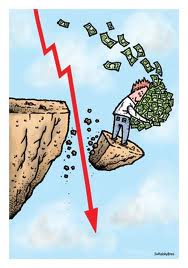
It should be clear by now that capitalism’s business cycle is driven by the credit system creating excessive leverage. The credit system separates the act of purchasing from the act of paying. People & organisations are paying with credit. The system itself is increasingly leveraged. This stimulates the market & allows production to grow temporarily beyond what the market can realise in the longer run; asset prices soar & so recorded profits. Eventually, the chain of credit breaks as lenders start to panic that they are over-leveraged. We get credit-crunch, financial crisis & recession. Fictitious capital along with real productive capital gets devalued, & as the law of value reasserts itself prices are brought back into line with their values.
It looks like that after half a century of trying to deny the law of value from acting in the form of a crisis that clears out the excessive leverage, the capitalist state has reached the end of the road. Further stimulus now risks currency debasement, which has already seen the $ fall in value from $35 an ounce of gold to over $5,500 at the beginning of 2026. Indeed, it is the $ no longer being tied to gold, along with US military power enforcing the $ as ‘world money’ that has permitted the stimulus that has allowed finance capital to grow the biggest asset price bubble in capitalism’s history.
As the world looks to escape the US economic blackmail that comes with having to use King $, & the limits of US military power are exposed, it is only a matter of time before the bubble bursts & finance capital, particularly US finance capital, is brought to its knees. It will be capitalism’s biggest crisis & still they will be trying to understand just why capitalism has crises.