Category Archives: Uncategorized

Marx’s Theory of Value

The core problem for today’s economics is a subjective theory of value.
No-one wants to tackle this because it exposes the economics profession to be an ideological prop rather than the science it was back in the days of Ricardo.
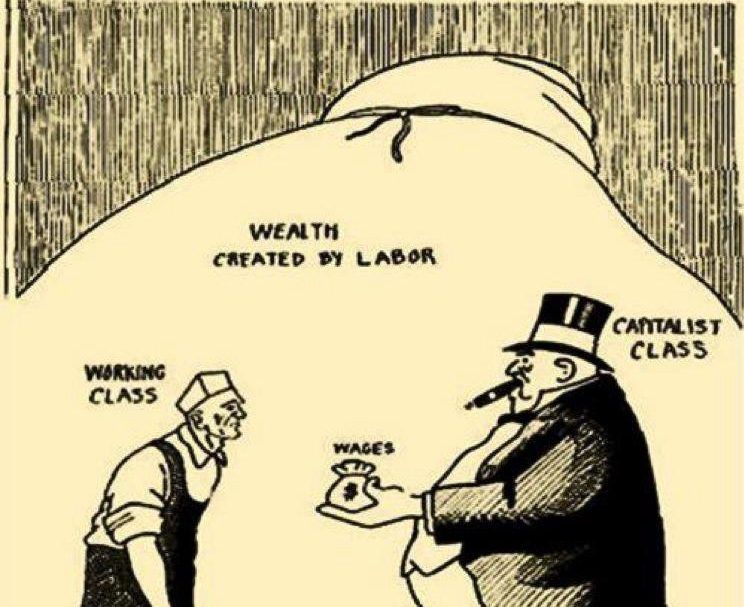
For the classical economists (not neo-classicals) value was objective. There were ‘natural’ prices which market prices deviated around due to fluctuations in supply & demand. These natural prices were determined by labour time. But the problem Ricardo couldn’t figure out was if prices were determined by labour time & labour power itself was sold at its ‘natural’ price, where did profits come from?
This suggested that profits came from capitalists not paying workers in full, & so we got the Ricardian Socialists. The reaction from the economics profession was to dump the labour theory of value & embrace marginalism.
Continue Reading

Where Does Profit Come From?

Money was around before capitalism. There was some commodity production in pre-capitalist societies. Commodity production being production for the purpose of selling the commodity for money, not production just to fulfil an immediate need. Capitalism is obviously based upon commodity production. Capitalists produce commodities to sell at a higher price than cost. They aim to make a profit.

Continue Reading

A Beginner’s Guide to Marx’s Capital

“A critique of political economy” was the subtitle of Marx’s book Capital. The political economists portrayed profit, rent & wages as the just returns for the three factors of production: land, labour & capital. Marx argued that such surface level appearances were seriously misleading. That both profit & rent actually came from value created by workers. Furthermore, that capitalism was just the latest mode of production, & that because of its contradictions would be replaced by a higher form called communism.

Continue Reading

Labour Values & Exchange-Values

A commodity takes a certain amount of time to produce. This amount of labour time has an equivalent in the form of the commodity that acts as money, historically gold. So with gold acting as money the market price, if sold at it’s value equivalent will be a weight of gold equivalent to the amount of labour time that went into its production. This is the simplifying assumption Marx makes in Volume I of Capital.
Now of course commodities in different industries have different turnover times & different labour-capital intensities; hence Marx’s ‘prices of production’ in Volume III. Still with the simplifying assumption that aggregate prices of production equate with aggregate values.
With supply & demand fluctuations market prices do not even equate with prices of production, unless by accident. But even here we can still say aggregate market prices will equate with their value equivalents.

Continue Reading

The Problem For Those Who Have Never Read Marx

The problem for those who have never read Marx, or at least never had it explained to them, is they seem to think the political system we get is based upon ideas, & that the word ‘communism’ simply represents a bad idea, even if by that they mean ‘good’ idea in theory, but results in a ‘bad’ reality.

Continue Reading

The Legacy of the Russian Revolution

There was considerable debate in Marxist circles before the Russian Revolution as to whether Russia could have a proletarian revolution or not. Whether it should limit itself to a bourgeois revolution, like the French one. Marx being the scientist that he was, was open to the possibility; as we couldn’t know for sure, in advance, that it wasn’t possible.

RussianRevolution.jpeg

However, given the fact that workers made up probably less than 5% of the population, a pure workers’ revolution didn’t seem realistic. But could an alliance with the peasants, rather than the emerging capitalist class, defeat the feudal class of landowners & continue to communism rather than stopping at capitalism? Trotsky, who was initially a Menshevik, not a Bolshevik, thought so & his theory of permanent revolution won over Lenin, who was initially sceptical. Lenin knew though that Russia could only be the ‘weak link’ in the world economy & that ‘socialism in one country’ wasn’t a possibility. The revolution had to spread, preferably to Germany, France & Britain for it to be successful. It didn’t, largely due to the reformism of the Social Democratic Party in Germany & the Labour Party in Britain. Not forgetting the involvement of British & other foreign troops in fermenting civil war.

Continue Reading

Historical Materialism

The problem in politics is many people have a poor understanding of what drives human history. They have a view based upon idealism rather than science. In philosophical terms, idealism rather than materialism. They think that it is purely a battle of ideas without understanding the material basis for these ideas.

Historical Materialism

If we look at the broad brush of human history we see technological change as a driver of changes in economic systems: pre-agriculture hunter-gather societies, slave & feudal systems of agricultural societies &  the capitalism of industrialised societies today. With these changes come changes in productive relations in society. With agriculture we get class based societies: those who control the land & those who work the land, e.g. landlords & serfs; with capitalism we get those who control (own) capital, whether in the form of factories or just money capital, & those who have to work – hence the class based nature of our society. As all profit ultimately comes from the workers’ labour, we have the class struggle between profit & wages.

Continue Reading

Copyright © 2026. Powered by WordPress & Romangie Theme.