The core problem for today’s economics is a subjective theory of value.
No-one wants to tackle this because it exposes the economics profession to be an ideological prop rather than the science it was back in the days of Ricardo.
For the classical economists (not neo-classicals) value was objective. There were ‘natural’ prices which market prices deviated around due to fluctuations in supply & demand. These natural prices were determined by labour time. But the problem Ricardo couldn’t figure out was if prices were determined by labour time & labour power itself was sold at its ‘natural’ price, where did profits come from?
This suggested that profits came from capitalists not paying workers in full, & so we got the Ricardian Socialists. The reaction from the economics profession was to dump the labour theory of value & embrace marginalism.
The diamonds versus water paradox meant utility theory couldn’t explain value based upon its usefulness & had to incorporate scarcity in the form of an additional unit. This determination of value based upon consumer preferences, not production, cannot measure ‘utility’ directly, just as one cannot measure ‘happiness’. All we have is graphical representations of preferences.
The Cambridge Capital Controversy exposed the problems of measuring capital; the ‘aggregation problem’ of trying to sum different use values. Marx had already solved this problem, & the problem of trying to determine the quantity of capital independently of the rate of interest/profit. He was able to do so because he understood capital to be a social substance based upon abstract, social labour time. This is what all commodities, whether capital or consumer goods, have in common & what enables us to compare them against one another in terms of prices, & so determine the amount of society’s limited labour time that is allocated to each of them.
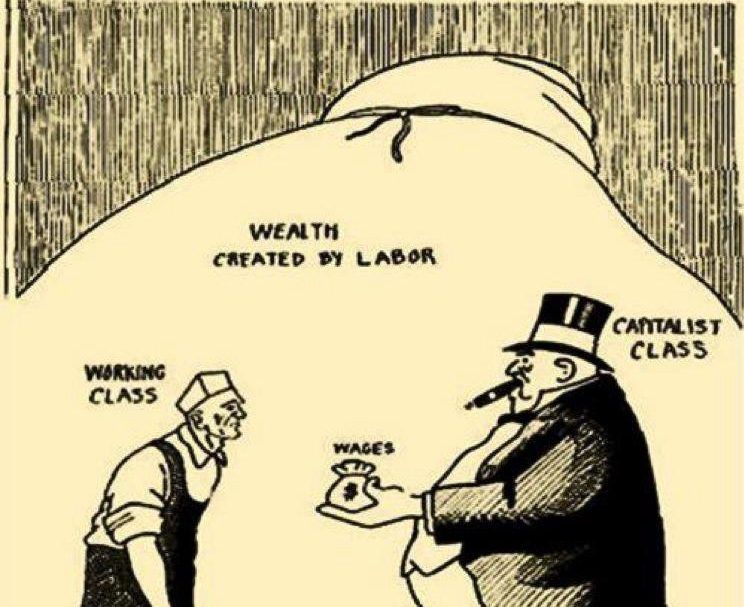
Furthermore, Marx was also able to resolve Ricardo’s conundrum of where profits come from by distinguishing between labour & labour power. Workers do not sell their labour but their ability to labour, i.e. their labour power. It is this that has a price in the form of the wage, but the labourer creates more value in the commodities than the value of his labour power.
Also, there is the misunderstanding that the labour theory of value explains the price of individual commodities in terms of labour time. Different ratios of capital to labour in different industries & firms mean labour values are transformed into ‘prices of production’, thus giving the illusion that all capital, whether in the form of purchased labour or purchased machinery & raw materials, earns a profit.
Additionally, the claim that the ‘transformation problem’ from labour values to prices of production invalidates Marx’s labour theory is to misunderstand what is claimed. Market prices will only tend towards prices of production as fluctuations in supply & demand will constantly cause them to deviate; much like equilibrium theory. Also, the aggregate prices of production may not equal their aggregate labour value equivalent because luxuries consumed by capitalists & the means of destruction, both of which fall out of the circuit of capital, are likely to have higher compositions of capital (capital to labour), so that the sum of prices of production may well be lower than the sum of labour values. That doesn’t negate the law of value, just as aeroplanes don’t negate the law of gravity.
From such an objective theory of value it is then possible to see how money created without any basis in production can distort aggregate prices from values & lead to the business cycle of boom & bust. These crises of overproduction of commodities are inherent to capitalism because capitalism is the ultimate expression of commodity production: the production of commodities not for their own sake, but to sell for a greater sum of money than initially laid out (M-C-M’). It is leverage in the form of excessive creation of token & credit money than enables production to get ahead of what can be realised in the long-run. Eventually debt saturation, financial crisis & recession with production being brought back in line with the growth in real labour time.
This problem was to a certain extent kept in check with a gold standard as gold can act as the objective measure & expression of labour values; an ounce of gold takes a certain amount of labour time to produce, so all other commodities can be measured in terms of weights of gold. It didn’t stop leverage & speculation, but if you could change your money into gold at a fixed rate it placed limits on money creation. Since 1971 finance capital has removed this obstacle & money creation has gone into overdrive. Little wonder now that much of recorded profit stems simply from asset price inflation; missing out commodity production altogether as we go straight from money to more money (M-M’).
2008 saw the speculative bubble pop & brought capitalism to its knees (well, at least in the form of Hank Paulson, for those who remember). More money to bail out the bankers has given the impression of a fix & conveniently an excuse to impose austerity & reduce labour costs. This ‘extend & pretend’ has its limits which we are probably getting close to. Then we can have another round of ‘rethinking’ economic theory.